
How to Mix Vintage and New Decor Without Making a Room Feel Cluttered
Mixing old and new isn't the difficult part.
Most of us do that instinctively—a piece inherited from a grandmother, a lamp bought last spring, a chair found at a barn sale on a Saturday.
The difficulty comes a few months later, when the room has quietly filled and something about it begins to feel heavy.
And often, the instinct is to blame the vintage.
It usually isn't the vintage.
Clutter is rarely a question of how many old things are in a room. It's more often a question of hierarchy: what the eye is meant to notice first, what it finds next, and where it's allowed to rest.
A room can hold quite a lot when everything isn't asking for attention at the same time.
Let Some Things Work Harder Than Others
Not every object in a room needs to be interesting.
In fact, a room can become tiring when every single thing is asking to be noticed.
Some pieces can simply do their job. A comfortable sofa. A simple lamp. A useful basket. A quiet rug.
Others can carry more of the room's character.
An old cupboard can store dishes while giving the room history. A vintage table can anchor an entire kitchen while still being the place where everyone eats dinner. An antique mirror can fill a wall without requiring much else around it.
The best pieces often do both.
Instead of asking whether you have too much vintage or too much new, look around the room and ask a different question:
How many things are trying to be the most interesting thing in the room?
If the answer is nearly everything, that may be where the cluttered feeling is coming from.
Don't Worry About Getting the Ratio Right
There is no perfect formula for mixing vintage and new.
You don't need thirty percent vintage or sixty percent new. And you certainly don't need to start counting furniture.
It can help, though, to let one or the other establish the overall character of the room.
A newer room might need only a handful of substantial vintage pieces to soften it and give it a sense of history.
An older room filled with antiques might benefit from a few simpler, newer pieces that give everything else some breathing room.
The balance can change from room to room.
What matters isn't the percentage.
It's whether the room feels as though the different pieces belong to the same conversation.
Leave Somewhere for the Eye to Rest
One of the easiest ways to calm a room costs absolutely nothing.
Clear something.
An entire mantel. A stretch of kitchen counter. The top of a small table. Half of a bookshelf.
Then resist the urge to immediately fill it again.
Empty space can feel wasteful when you love objects. There is always another pitcher, candlestick, stack of books or little painting that could fit.
But the empty space is doing something important.
It's allowing you to actually see the things that remain.
A single lamp on a table can be beautiful because there's nothing beside it competing for attention. Three pieces of pottery grouped at one end of a shelf have more presence when the other end isn't filled simply because there was room.
You don't need minimalism.
You just need somewhere for the eye to stop.
Group Rather Than Scatter
A collection spread evenly throughout a room can start to feel like clutter.
Gather the same objects together and something changes.
They become a collection.
Three pieces of ironstone grouped on a shelf read almost as one visual object. Put one on the mantel, one on a side table and one on the windowsill and suddenly the eye has three separate things to process.
Trays can help. So can shelves, cupboards, tabletops and walls devoted to a particular kind of object.
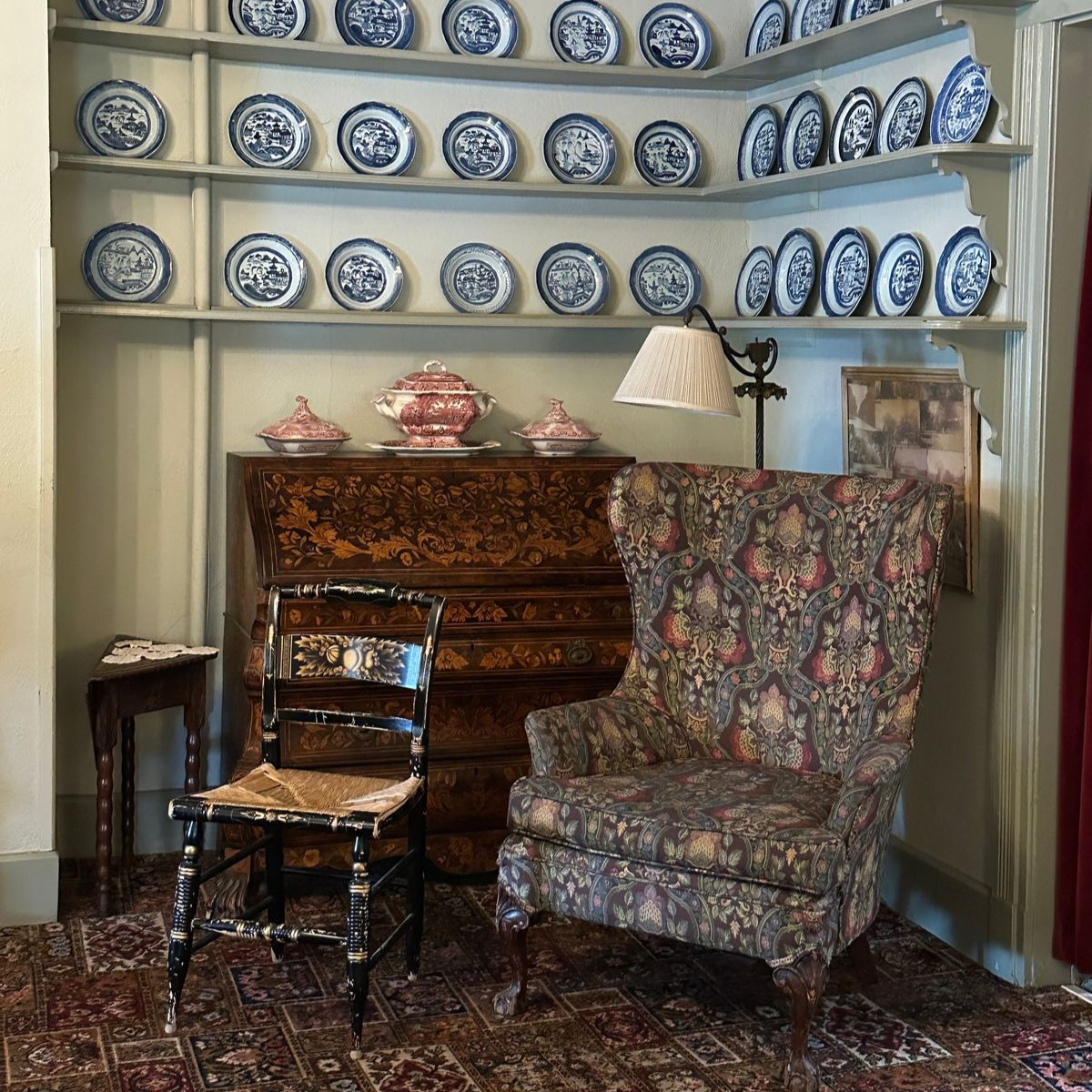
A group of transferware hung together feels intentional.
A handful of brass candlesticks gathered on a table feels like a collection.
A row of old cutting boards leaning together against the kitchen wall has more impact than one cutting board in every corner.
The point isn't to organize everything by category.
It's simply to give the things you love a little company.
Let Vintage Take a Big Role
One of the easiest mistakes to make when mixing old and new is relegating all the vintage pieces to small decorative objects.
A little vase here.
A candlestick there.
A tiny framed painting.
A bowl on the table.
A basket on the shelf.
Individually, they're lovely. Together, they can become visually busy because the room's character is being carried by dozens of small things.
Sometimes the answer isn't less vintage.
It's bigger vintage.
An old farmhouse table.
A painted cupboard.
A substantial mirror.
An antique dresser used in a hallway.
A large piece of pottery filled with branches.
One substantial old piece can give an entire room character without requiring twenty smaller objects to do the same job.
And because it has presence, everything around it can afford to be quieter.
Keep the Palette Connected
One of the easiest ways to make different periods and styles live comfortably together is through color.
They don't need to match.
They simply need to relate.
Cream, oatmeal, faded blue, dusty rose, soft green and old wood can coexist beautifully because they share a similar softness.
The same is true of stronger palettes. The particular colors matter less than whether they seem to belong in the same world.
A quieter palette also gives you more freedom to layer.
When the colors relate to one another, a room can hold considerably more pattern, age, texture and variation without feeling noisy.
This is especially helpful when mixing textiles.
A floral doesn't necessarily need another floral. Put it beside a stripe or a check that shares one or two of its colors and the relationship often becomes far more interesting.
Mix Scale, Not Just Style
Sometimes what feels like clutter isn't actually about the number of things in the room.
Everything is simply the same size.
A row of small objects across a mantel. Five little frames on a wall. Several small pillows lined up across a sofa.
Give the eye some variation.
One large object, a few medium pieces and something small can feel calmer than six similarly sized things, even though the room contains just as much.
The same principle applies to pattern.
A larger botanical print can sit comfortably beside a narrow stripe and a small check because each occupies a different visual scale.
Variation gives things room to coexist.
Rotate Instead of Accumulating
Loving something doesn't mean it has to be on display every day of the year.
Keep more than you show.
Textiles make this especially easy.
A drawer can hold striped tea towels, botanical prints, simple checks and a few plain ones. Pillow covers can change with the season. Napkins can appear for a few months and then give way to another set.
Vintage objects can work the same way.
A few pieces stay out. Others wait in a cupboard.
When something new comes into the room, something else can take a little rest.
The room stays legible.
The collection can keep growing.
And there's a wonderful side effect: something put away for a season often feels surprisingly new when you bring it back.
Remember That Collected Doesn't Mean Full
A home that has evolved over time doesn't need to display every chapter simultaneously.
Some things can leave.
Some can move to another room.
Some can wait in a cupboard.
And occasionally, something you once loved simply doesn't belong anymore.
Editing isn't a rejection of collecting. It's part of it.
The goal isn't to own as little as possible.
It's to be able to notice what you own.
How We Think About It at Hazel
Nearly everything we source is found one piece at a time.
Estate sales, antique shops and barn sales rarely hand you a perfectly coordinated room—and that's exactly what we love about them.
The things we make are designed with that same kind of home in mind.
Our textiles take their cues from patterns and colors that have been around for generations: ticking stripes, faded florals, botanical motifs and simple woven checks.
They're meant to feel comfortable beside the things you already own, whether those things were inherited, found at an estate sale or bought last Tuesday.
A new piece doesn't need to pretend to be old to live happily beside something that is.
And a tea towel shouldn't require a coordinating kitchen.
It should simply look as though it belongs there.
Because mixing vintage and new isn't really about finding the perfect formula.
It's about leaving enough room—for age, for usefulness, for beauty and for the things you haven't found yet.
A home should have a little space left to become itself.
Frequently Asked Questions
What's the right ratio of vintage to new in a room?
There isn't one. Instead of trying to reach a particular percentage, think about which pieces are establishing the character of the room. One substantial antique can sometimes provide more warmth and history than a dozen smaller vintage accessories. Let the balance develop naturally and allow it to vary from room to room.
How do I keep vintage decor from looking cluttered?
Give vintage pieces some breathing room and consider grouping smaller objects rather than scattering them throughout the room. A few pieces displayed together tend to read as a collection, while the same number spread across several surfaces can feel visually busy.
Should vintage pieces be functional or decorative?
They can be either—and some of the best pieces are both. An antique table, cupboard, dresser, basket or piece of pottery can add character while still being useful. Using vintage pieces rather than treating all of them as decoration can actually help a room feel less cluttered.
Is it okay to mix different wood tones?
Absolutely. Different wood tones can make a room feel as though it developed over time. Look for some relationship between them—similar warmth, repeated tones elsewhere in the room or enough repetition of wood that no single piece feels out of place.
My room already feels cluttered. Where should I start?
Clear one surface completely. Live with the empty space for a few days before deciding what, if anything, should return. You may find that you don't miss everything that was there. From there, group smaller collections, remove anything competing unnecessarily for attention and give your favorite pieces more room around them.
How can new pieces work alongside genuine antiques?
Focus on materials, color and character rather than trying to make something new look old. Natural fibers, traditional patterns, simple finishes and colors that relate to the older pieces in the room can help different eras sit comfortably together. A new object doesn't need artificial distressing to belong beside an antique—it simply needs to feel at home there.